
Retired Police Detective, 20 Years:
Every Kid in This Video Knew the Rules. The Hidden Cameras Didn't Care.
45% Off + Free Shipping
Shop Now
News segment: KARE 11 (Minneapolis) reporting on the "Aim for Safety" hidden-camera program at Cook Children's Hospital, Fort Worth. Shown for reporting context — KARE 11, Cook Children's Hospital, and the American Academy of Pediatrics are not affiliated with, and do not endorse, any product on this page.
The children in that news report were briefed — stop, don't touch, run, tell an adult — then left alone in a room where an ER doctor's team had hidden three disabled guns. As reported in the segment, 93% of kids who've gone through the program found one. Most picked it up. I spent 20 years watching the same gap from behind a badge. Here's what that test actually proves — and the piece of the answer the broadcast never got to.
 Tom Pierce - Retired Police VeteranUpdated August 14, 2026
The test wasn't rigged. The kids weren't careless. Something else failed — and I watched it fail for 20 years.
Watch the setup again: the parents confirm their kids know the rules. The rules go up on screen — stop, don't touch, run, tell an adult. Minutes later, a boy is holding the gun and looking down the barrel while his mother covers her face in the next room.
The doctor running the program says the quiet part out loud: "That's the first thing they do. That's an instinct." And the anchor closes the loop at the end — these kids had been talked to, and recently. The talking wasn't stale. It just wasn't the thing that drives hands.
Safety researchers have a name for what the cameras caught: the recite-versus-react gap. Knowing a rule and performing a rule are two different skills, stored in two different places. Under surprise and curiosity, the spoken rule loses to the hands. I came up through the Miami Police Department, patrol to detective, and I never met a rookie who learned safe handling from a rulebook — there's only one thing that closes that gap, for recruits and for kids: rehearsal. Doing the safe motion, physically, over and over, until it's not a decision anymore.
iHimle, Miltenberger et al. (2004), Journal of Applied Behavior Analysis. In controlled studies, children performed the safe response after physically rehearsing it — not after simply being told the rules.
Here's the detail most people miss in the segment: the hospital's own method is rehearsal on a firearm that cannot fire. Decommissioned guns, staged rooms, supervised practice at telling the difference between knowing and doing. That's the idea. The only problem with it is that your family can't fly to Fort Worth and run it every week.
What follows is the at-home version of that same idea — on an object that is unmistakably, at any distance, a toy.

The place the test is really about: somebody else's house, where your rules — and your safe — don't travel.
The anchor was right — and one inch short
Lock the Gun. And Build the Reflex.
The segment ends with the American Academy of Pediatrics' push: safe storage matters more than conversation. They're right — I gave parents that exact advice for 20 years. If there's a firearm in your home, lock it. That was never the debate.
But run the anchor's own logic one step further. Roughly one in three American homes has a firearm, and about half of loaded ones aren't fully locked up. Your safe is bolted to your floor. Your kid isn't. The sleepover, the cousin's place, the grandparent's closet — the test in that video is a dress rehearsal for a room you will never get to childproof.
The safe covers your house. The reflex covers every house. It was never either/or.
iJAMA Network Open (2026); CDC BRFSS. ~1 in 3 U.S. households own firearms; about half of those with a loaded firearm keep at least one unlocked.
"We don't have guns in our house — but I know several people that do."
— a mother whose son took part in the test, in the KARE 11 segment above
"It's something that we need to address with our friends when they go to sleepovers."
— a parent in the KARE 11 segment above
Try this tonight — it takes 60 seconds
Ask your kid to say the four rules. Most kids who've had the talk will nail it.
Then hand them a banana, a stapler, anything — and ask them to show you with their hands what they'd do if they found a real one at a friend's house. Where do the hands go? Where do the feet go? Who do they tell, and in what order?
If the second answer is slower, vaguer, or improvised — that's the gap the hidden cameras caught. Not a knowledge problem. A rehearsal problem. Keep reading.
360°
↔ Drag to spin
Spin it yourself — there is no angle, and no light, where this reads as a weapon. That's the point.
About "it may look like a toy…"
The Danger Is a Gun That Looks Like a Toy. This Is the Opposite.
The hospital's program slide warns that to a child, a real gun "may look like a toy." That confusion — realistic look, deadly function — is exactly the hazard.
A trainer has to run the other direction: look nothing like a real firearm, and work like one everywhere the teaching happens. Bright primary-colored building bricks that no one, at any distance, in any light, mistakes for a weapon — wrapped around a real manual of arms: a magazine that loads and drops free, a slide that racks, a casing that ejects with every shot, and a slide that locks open on an empty chamber.
All of the realism goes into the function, where it teaches. None of it goes into the appearance, where it could confuse anyone.
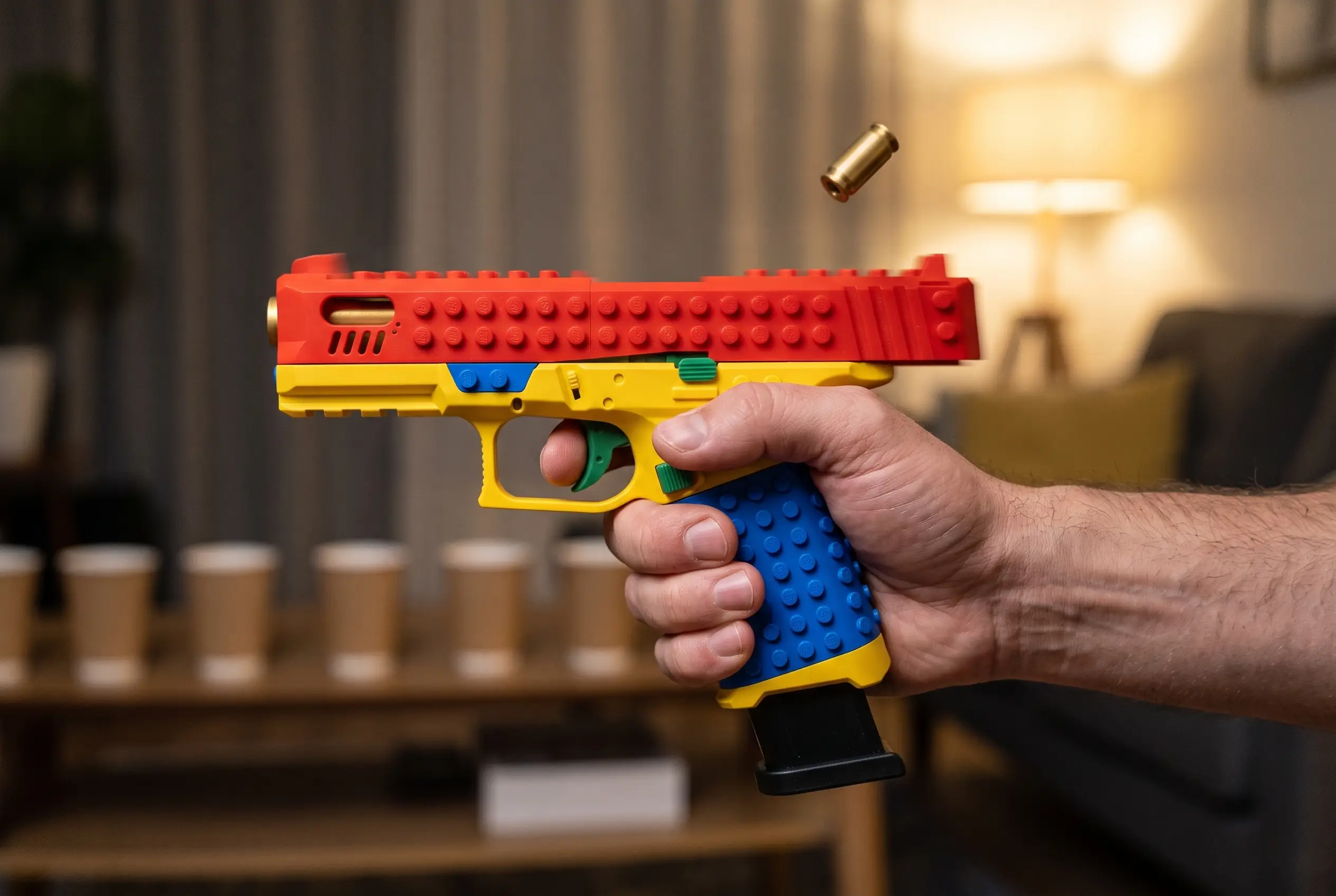
Every trigger pull sends the soft dart, ejects the spent casing, and chambers the next round — the same cycle his hands will remember.
The rehearsal, at your kitchen table
Fifty Honest Reps in an Afternoon — Without Either of You Calling It a Lesson
Load six soft rounds into the magazine. Seat it with a palm tap. Rack the slide. Fire — brass kicks out the side port. After the sixth, the slide locks open on an empty chamber: he looks in, sees it's clear, says so, reloads. Muzzle stays pointed safe. Finger stays indexed until sights are on the paper cup.
That's stop-don't-touch's missing other half: not what to avoid, but what trained hands actually do around anything gun-shaped — rehearsed until it's boring. And because it's a brick toy he can customize and plink cups with, he runs the reps on his own. Nobody has to schedule practice.
The At-Home Version Of The Idea
Meet The BlockBlaster™
A brick-built safety trainer that arrives fully built — so the rehearsal the hidden-camera program runs in a hospital playroom can happen at your kitchen table, tonight, with soft-tip darts and paper cups.

✓The BlockBlaster™ Safety Trainer — fully builtRacks, fires, ejects, locks open on empty. The full cycle, out of the box. No assembly, no batteries, no screen.
✓Included1 magazine + 6 reusable casings + 12 soft-tip dartsLoad every casing twice over — spares for the ones the couch eats
✓Bonus customization blocksEvery studded surface takes standard building bricks — he makes it his, so the reps keep happening
✓5 colors — including the Brick editionIt sells out first
+OptionalThe Safe-Handling Guide — $20 at checkoutEvery drill on this page, sequenced step by step — you don't need to know any of it going in
[REASON-WHY — one true sentence on why the 45% exists, e.g. a restock-cycle or new-colorway reason. Per the SOP, the reason-why is the cheapest missing layer — fill it with what is actually true, or delete this line.]
Sold out 6 times since May — back in stock now
This is a try, not a buy.
Run the drills for 30 days. If your kid doesn't love it — or you don't love what it teaches — send it back for a full refund. No forms, no fight. The risk of testing whether rehearsal beats recitation in your house is ours, not yours.
Choose your kit below ↓
From verified buyers:
"A great training tool"
★★★★★
"This is a great training tool! So excited to teach safety in the classroom with this! Great product!"
Kat · ✓ Verified Buyer
"Kept him busy the whole day"
★★★★★
"Great gift. Bought it for my 15 yr old grandson for Christmas. He loved it — kept him busy the whole day. Definitely recommend."
Tiffaney · ✓ Verified Buyer
"Best present ever"
★★★★★
"My great nephew picked it out as an early Christmas present and is overjoyed with it!"
Connie G. · ✓ Verified Buyer
"So much fun!"
★★★★★
"I bought it as a Christmas gift and he loved it. Excellent!"
Mommy · ✓ Verified Buyer
Reviews verbatim from verified purchases at block-blaster.com · rated 4.5★ by 60,000 parents
This page is an advertisement for The BlockBlaster™ (block-blaster.com), not a news publication. The embedded video is a KARE 11 (Minneapolis) news report on the "Aim for Safety" program at Cook Children's Hospital, shown for reporting context; KARE 11, Cook Children's Hospital, Dr. Daniel Guzman, and the American Academy of Pediatrics are not affiliated with and do not endorse this product. The "93%" figure is the program's own, as reported in that segment. The BlockBlaster™ is 100% a toy: brick construction, spring power, soft-tip darts. It is a trainer for safe-handling habits — not a substitute for secure storage, adult supervision, or real-firearms instruction. Lock the gun. Build the reflex. Studies cited: Himle, Miltenberger et al. (2004), JABA; JAMA Network Open (2026); CDC BRFSS. Not affiliated with the LEGO Group; compatible with standard building bricks.